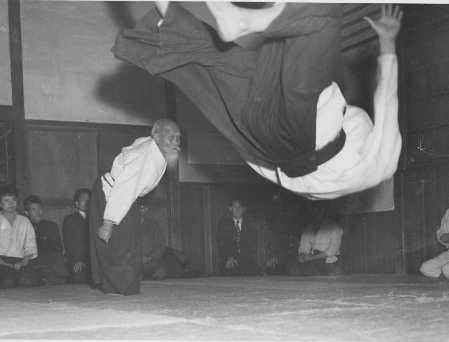
Kokyū-ryoku (呼吸力) is commonly translated as “breath power.” In Aikidō, however, it points to a broader principle: the capacity to generate and transmit force through the coordination of the body, breathing, and intention. Developing this capacity makes effective action possible without relying solely on muscular tension. Power emerges when the body functions as an integrated structure, with stability, continuity, and a clear direction.
One foundation is movement organized around the tanden (丹田), the lower-abdominal region traditionally used as a reference for balance and coordinated movement. The feet establish support, the hips direct movement, and the arms transmit force while maintaining their connection with the trunk. When these parts act in isolation, movement loses efficiency; when they work together, even a simple action can convey considerable force. Relaxation has a technical purpose: it reduces unnecessary tension that hinders mobility, sensitivity, and the transmission of force.
This principle can be studied through kokyū-hō (呼吸法), a traditional Aikidō exercise. In its seated form, uke grips nage’s wrists while nage learns to maintain sound structure, connect the arms to the centre, and direct movement to create an imbalance. The exercise exposes a common mistake: trying to overcome a partner’s resistance through the shoulders and arms alone. Progress comes as body orientation, movement, extension, and contact begin to function together.
Breathing accompanies this process, helping regulate effort and the rhythm of action. Distance, timing, and the ability to perceive changes in uke’s balance also matter. Kokyū-ryoku is therefore studied in fundamental exercises as well as in throws, pins, and body movement. Its development calls for consistent, attentive practice that can be tested with a partner.
武産の武の阿吽の呼吸の理念力
Morihei Ueshiba · Teachings on takemusu and A-un breathing
Morihei Ueshiba connected this principle to a deeper dimension of Budō. His teachings include the Japanese expression 武産の武の阿吽の呼吸の理念力, associating takemusu —the emergence of techniques— with the power of the principle of A-un (阿吽) breathing. It presents breathing, movement, and the creation of technique as aspects of a single process.
To cultivate kokyū-ryoku is to develop a way of using the body in which stability, sensitivity, and effectiveness advance together. It is a key to understanding how Aikidō technique can be performed naturally, precisely, and with power arising from coordination.
Terminology for kokyū-ryoku and kokyū-hō: Aikido Terminology. The Japanese wording attributed to Ueshiba is discussed by Aikido Sangenkai, with reference to Aiki Shinzui.